
One of the most exciting color mixing activities for preschool is watching children discover that two colors can create an entirely new one. Instead of simply telling my students that blue and yellow make green or red and blue make purple, I wanted them to become little scientists and discover it for themselves.
In this preschool science lesson, we explored color mixing through two engaging picture books, White Rabbit’s Color Book and Mouse Paint, completed a FREE color mixing recording sheet, experimented with paint in sensory bags, and created a colorful bulletin board that celebrated each student’s discoveries.
If you’re looking for hands-on preschool science activities that combine literacy, art, and STEM learning, these three simple color mixing activities are always a classroom favorite.

Why Teach Color Mixing in Preschool?
Color mixing is one of the best preschool science activities because it encourages children to observe, predict, experiment, and discover. Instead of memorizing that yellow and blue make green, preschoolers experience the learning firsthand. This simple science concept also strengthens vocabulary, critical thinking, and problem-solving skills while making learning exciting and meaningful.
One of my favorite ways to teach color mixing in preschool is by combining literacy with hands-on science. We began our lesson by reading two wonderful picture books, White Rabbit’s Color Book by Alan Baker and Mouse Paint by Ellen Stoll Walsh. Both stories naturally introduce primary and secondary colors while keeping young learners engaged.
Throughout the week, my students completed three different color mixing activities. Each one helped reinforce the same science concept in a new and exciting way.
Activity #1: White Rabbit’s Color Book Painting Activity (FREE Printable)

This activity is inspired by White Rabbit’s Color Book and has become one of my favorite preschool color mixing activities because it combines literature, art, and science in one simple lesson.
After reading the story, we talked about the three primary colors—red, yellow, and blue. Before mixing any paint, I asked students to predict what they thought would happen when two colors were combined. Making predictions is an important science skill, and preschoolers love sharing their ideas before testing them.
Students then used the FREE color mixing printable to paint each pair of rabbits with the correct primary colors. Finally, they mixed the paints together to discover the new secondary color that appeared.
This simple activity helped students see that:
- Blue + Yellow = Green
- Red + Blue = Purple
- Red + Yellow = Orange
Not only were they learning about colors, but they were also practicing observation, making predictions, and recording their discoveries like real scientists.
💛 Grab your FREE White Rabbit’s Color Mixing Printable to use with your preschool or Pre-K students. Just click HERE to download it from my TPT store.
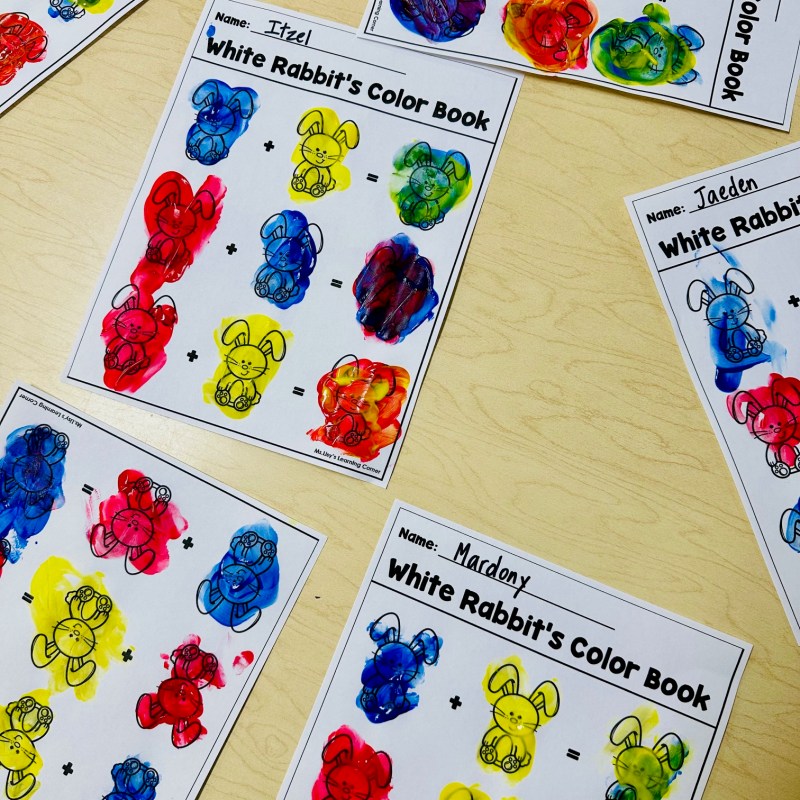
My preschoolers absolutely loved discovering the new colors they created. Watching them make predictions, test their ideas, and proudly share their colorful rabbits made this one of our favorite preschool science activities. This color mixing activity for preschool helps children explore primary and secondary colors through hands-on learning.
Activity #2: Mouse Paint Sensory Bag Color Mixing Experiment

This was definitely the most exciting part of our color mixing activities for preschool because every student became a little scientist.
After reading Mouse Paint by Ellen Stoll Walsh, we talked about how the three mice discovered that mixing primary colors creates brand-new colors. Then it was time for my preschoolers to experiment on their own.
To make the activity even more meaningful, I drew one of the little mice from the story on each zip-top bag with a permanent marker. My students loved seeing their own “paint mouse” inside the bag as they squished and mixed the colors together. It was a simple addition that connected the science experiment back to the story and made the activity even more engaging.
I added small drops of red, yellow, and blue paint into each bag before sealing it. Students predicted what new color would appear, then pressed, squished, and mixed the paint with their fingers until they discovered the secondary colors.
Since all of the paint stayed inside the bags, this became a mess-free preschool science activity that was perfect for little hands while strengthening fine motor skills.
Materials
- Zip-top sandwich bags
- Washable red, yellow, and blue paint
- Permanent marker (to draw the mouse)
- Packing tape (optional, for extra security)
- Mouse Paint by Ellen Stoll Walsh

Teacher Tip: Personalize your sensory bags to match the book you’re reading! I drew the mouse from Mouse Paint on each bag, but if you’re reading White Rabbit’s Color Book, simply draw a bunny instead. This simple touch helps connect the literacy lesson to the hands-on science activity and makes the experiment even more engaging for preschoolers.

Teacher Tip: I recommend sealing the top of each zip-top bag with packing tape before giving it to students. It helps prevent accidental spills and makes the sensory bags last much longer.
Bringing Our Learning Together
After everyone finished their preschool color mixing experiment, we displayed each student’s sensory bag around our science investigation board. We included our question, materials, procedure, predictions, and conclusions so students could revisit the experiment throughout the week.
Displaying our work this way turned our classroom wall into an interactive science display and gave students the opportunity to explain what they had learned to classmates, teachers, and families. It was a wonderful way to celebrate their discoveries while reinforcing the science concepts we had explored.

Our completed color mixing science investigation board displayed each student’s sensory bag alongside our class question, predictions, procedure, and conclusions.
Activity #3: Color Mixing with Food Coloring and Water

After exploring color mixing with paint and our sensory bags, we revisited the same science concept using food coloring, water, and paper towels. This simple preschool color mixing activity gave students another opportunity to predict, observe, and discover how primary colors create new colors.
Each student was given a paper towel, a paintbrush, and three small cups filled with water colored red, yellow, and blue using food coloring. Before they began, we reviewed the primary colors and talked about what might happen when two colors were mixed together.
Students dipped their brushes into the colored water and painted directly onto the paper towel, experimenting with different color combinations. As the colors spread across the paper towel, they eagerly watched new colors appear right before their eyes.
This activity reinforced that:
- Blue + Yellow = Green
- Red + Blue = Purple
- Red + Yellow = Orange
Because the paper towel quickly absorbed the colored water, students could clearly see how the colors blended together. It was another simple hands-on preschool science activity that encouraged curiosity, observation, and experimentation.
Materials
- Paper towels
- Small cups
- Water
- Red, yellow, and blue food coloring
- Paintbrushes
💡 Teacher Tip: Before students begin painting, ask them to predict which new color they think will appear. After they finish, compare their predictions with the actual results. This encourages scientific thinking and builds important observation skills.

Activity #4: Creating a Preschool Color Mixing Bulletin Board
After completing our preschool color mixing activities, I wanted to give my students an opportunity to proudly display everything they had learned. We turned their completed White Rabbit’s Color Book recording sheets into a colorful preschool bulletin board that celebrated both science and creativity.
The bulletin board was inspired by White Rabbit’s Color Book by Alan Baker, making it a perfect extension of our literacy lesson. Each student’s finished recording sheet became part of our classroom display, allowing them to see how everyone discovered the same secondary colors in their own unique way.
To make the bulletin board even more interactive, I added a prediction chart in the center. Before we mixed any colors, students predicted what they thought would happen when two primary colors were combined. After completing the activities, we revisited our predictions and compared them with our actual results. This encouraged meaningful classroom discussions and helped reinforce the scientific process.
One of my favorite parts of this display was seeing how excited my preschoolers were to show their work to classmates, teachers, and families. Throughout the week, students proudly explained how they mixed colors to create green, purple, and orange, turning our bulletin board into an interactive learning display rather than just classroom decoration.
Whether you’re looking for preschool bulletin board ideas, color mixing activities for preschool, or a meaningful way to display student work, this bulletin board is an easy way to celebrate learning while brightening your classroom.
Teacher Tip: Don’t feel like you have to display every activity. I chose to hang the White Rabbit’s Color Book recording sheets because they created a colorful visual display, while our Mouse Paint sensory bags remained part of our science investigation area. Together, they reminded students of everything they had discovered during our color mixing unit.

Our completed color mixing bulletin board displayed each student’s recording sheet alongside our class prediction chart, creating a colorful reminder of everything we learned about primary and secondary colors
Conclusion
Color mixing is one of my favorite preschool science activities because it combines literature, art, and hands-on exploration in a way that is both fun and meaningful. By using White Rabbit’s Color Book and Mouse Paint, my preschoolers were able to make predictions, experiment with colors, record their discoveries, and proudly share their learning through a classroom bulletin board.
If you’re planning a preschool color mixing lesson, I hope these four activities inspire you to create an engaging learning experience for your students. From the FREE color mixing printable to the sensory bags, paper towel experiment, and bulletin board, each activity builds on the last while encouraging curiosity, creativity, and scientific thinking.
⭐ Don’t forget to grab your FREE White Rabbit’s Color Mixing Printable before you go! I hope your preschoolers enjoy these activities as much as mine did.
If you’re looking for color mixing activities for preschool, these four ideas are easy to set up and highly engaging for young learners.
Frequently Asked Questions
What are the best color mixing activities for preschool?
Hands-on activities work best! In this lesson, we explored color mixing through picture books, a FREE printable recording sheet, sensory bags, a paper towel experiment, and a colorful classroom bulletin board. These activities help preschoolers discover how primary colors create secondary colors through play and exploration.
What books teach color mixing to preschoolers?
Two of my favorite picture books are White Rabbit’s Color Book by Alan Baker and Mouse Paint by Ellen Stoll Walsh. Both introduce primary and secondary colors in a fun, engaging way and pair perfectly with hands-on science activities.
How do you teach primary and secondary colors in preschool?
I like to begin with a read-aloud, followed by hands-on experiments where students mix colors themselves. By allowing children to make predictions, test their ideas, and observe the results, they gain a much deeper understanding of color mixing than simply memorizing the answers.
Can I use these activities in Pre-K or Kindergarten?
Absolutely! These color mixing activities are perfect for Preschool, Pre-K, Transitional Kindergarten, and Kindergarten classrooms. They can easily be adapted to meet the needs of different learners.
Save This Preschool Color Mixing Lesson for Later!
If you found these color mixing activities for preschool helpful, be sure to save this post on Pinterest so you’ll have it ready for your next science unit.
More Classroom Ideas
Looking for more preschool bulletin board inspiration? Don’t miss my 4 Back to School Pre-K Bulletin Board Ideas.
About the Author
Hi! I’m Lisy, a kindergarten teacher and the creator of Ms. Lisy’s Learning Corner. I love creating hands-on learning activities that make learning fun and meaningful for young learners. Here you’ll find classroom-tested ideas, free printables, and engaging resources designed to help kindergarten and early childhood teachers save time while keeping students excited to learn.